Home
The home screen provides an overview of multiple aspects of Make (Figure 1).
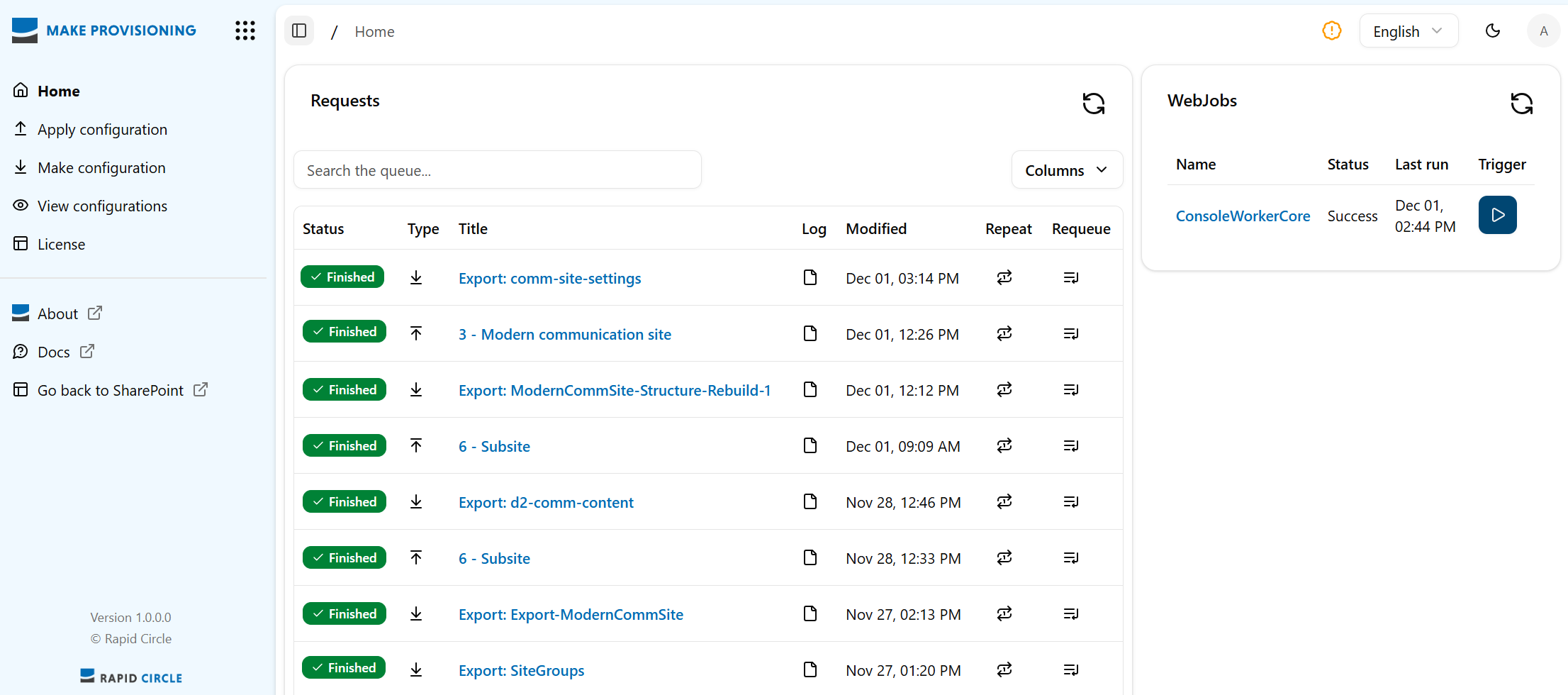
Figure 1: Home screen overview
Requests
The Requests section displays all pending and past requests in a clear table format. Users can search the collection using the dedicated input field or sort the table by clicking on the header of any corresponding column.
A request contains the necessary information to provision or update a new SharePoint site, Microsoft 365 group, or Team. When a new request is created on the Apply configuration page, it is added to the top of the table with the status set to ‘Queued’. When a WebJob is triggered, it selects a queued request and begins the provisioning process. When the provisioning is finished the status is set to either ‘Finished’ or ‘Error occurred’. Users can use the Repeat button to create a new request with the same configuration, or the Requeue button to place a request back into the queue after resolving the issue. Users should check the log for details when an error occurs.
WebJobs
The WebJobs section lists all active WebJobs and their current statuses. A WebJob is responsible for selecting a queued request and initiating the provisioning process. Multiple WebJobs may be present and active simultaneously, with each WebJob capable of provisioning a SharePoint site based on an individual request.
The table in this section provides the following information for each WebJob:
- Name: The identifier of the WebJob.
- Status: Shows the WebJob’s current activity:
- Initializing: The WebJob is retrieving a request from the queue.
- Running: The WebJob is currently provisioning a SharePoint site based on a request. The corresponding request’s status in the queue will change to ‘Processing’.
- Failed: Site provisioning has failed. The corresponding request’s status in the queue will change to ‘Error’. Users should check the log for details on the failure.
- Success: The site has been successfully provisioned. The corresponding request’s status in the queue will change to ‘Finished’.
- Last run: The timestamp of the last time the WebJob processed a request.
- Trigger: Clicking the Trigger button will manually start the WebJob. This action is typically unnecessary when the WebJobs are configured to run periodically within Azure.